Kids and teens with learning, sensory, emotional and behavioral differences are expected to constantly navigate a world that isn’t quite designed with them in mind. Putting in the steady, under-the-radar extra effort required to participate and engage can be exhausting and depleting. Over time, this “square peg, round hole” situation begins to whisper the quiet narrative, “you don’t belong.”
But when teachers, coaches, programs and organizations make simple shifts, they can meet students halfway. When we make a shift, it’s easier for neurodivergent children to be their authentic selves. We’re making space for them and allowing them to belong.
I’m hoping this list is a starting point for advocacy that you could share with a scout troop leader, trumpet teacher or team coach. I believe many organizations would like to be more accessible and welcoming, if they knew how. Here’s a list of possibilities that don’t take much effort or expense, but could help differently-wired kids thrive:
Ask for volunteers. Make reading-aloud to the group optional. If you go around the room or circle in order, students may feel embarrassed to ask to be skipped. It’s ideal if you ask for volunteers. Give kids the option to write answers or answer verbally, or perhaps to listen and observe.
Details
Students with dyslexia, anxiety, verbal articulation struggle, demand avoidance struggles, visual processing deficits or who process information more slowly can find required reading aloud stressful and distracting. Even if they are capable of doing it, the task can be more fatiguing to them than for their neurotypical peers. Allowing children to volunteer takes the pressure off. It stops this from becoming a thing where instead of truly participating in the activity, the student’s focused on when it will be their turn to read aloud and they’re counting down the page to know which paragraph will be theirs. Keep in mind that a kid or teen might not know they’re dyslexic. (Only about 20% of dyslexics are identified before leaving the K-12 school system.) They aren’t going to point out that reading aloud is anxiety-provoking. They’ll just be less likely to return to this group programming over time. Asking for volunteers for things like reading is a very common and reasonable 504 school accommodation that makes the activity accessible and inclusive.
Let kids hang out on the sidelines if they prefer it, when possible. Some kids are very happy to be a part of the group by proximity without the stress of actually playing the game or doing the group activity. Colored pencils and paper can be an alternative for anyone who wants to hang out with the group but not actively participate in the game or conversation.
Details
There are a number of things that can be going on to contribute to this, such as processing differences, anxiety, introversion and difficulty with social cues. From the sidelines, a child may be perfectly happy and feel like a part of the group, without the stress of participating in the game. If we don’t push and force, over time they may even be ready to join in the activity. If not today, then maybe another day. But, the win is that the child’s a part of the group in a way that works for them. This post from the Stimpunk Foundation (an advocacy group) explains a little more about how autistic or neurodivergent youth may especially appreciate onlooker play and parallel play.
Allow for wiggles. You can ask a fidgety neurodivergent child to sit still OR to listen well. It’s tricky to do both at the same time.
Details
Imagine that when you ask the child to sit still, they’re then thinking about the goal of being still instead of thinking about what the speaker is saying. Also, people with weak proprioception (the ability to sense where your body is in a space) tend to subconsciously use movement and sensory input to help their brain understand where their body is in space. Many neurodivergent people use repetitive motions called stimming, to help them stay emotionally regulated and calm. That means that their outward movement = calm insides. Being required to sit still takes away their calm and their body’s sense of orientation in space.
Keep awareness and flexibility for sensory sensitivity. Fluorescent or bright lights, loud noises or buzzing, crowded environments, itchy tags, blaring speakers can all be difficult.
Details
Certain noises, lights and textures can cause sensitive children headaches or other pain, anxiety and distraction. They might not be aware or able to articulate that the noise/light/texture is what’s causing the problem. Headphones, Loops ear plugs, natural light, sensory breaks and changing locations in the room can help. Kids with sensory sensitivities may be selective eaters. It can help if there isn’t pressured expectations about food.
Offer name tags or remind kids of everyone’s names. This is super helpful for children who struggle to remember names. Remind the group of everyone’s names when you’re starting the next class, even if you think everyone “should” know each other’s names by now.
Details
People with face blindness or other struggles with matching names to faces can really have a difficult time with names. When you’re in a group and can’t remember people’s names, it’s difficult to make connections. “Hey, you!” after you’ve known someone a month is awkward. The name tag or name reminder is a huge help. Struggling to recognize faces can elevate social anxiety.
Pause and wait. When you ask a child a question, pause a few extra seconds before you talk again or try to prompt them. This allows time for the child to process, muster courage and gather words. If you speak too soon, you’ll interrupt the process and they’ll need to start it all over again, and they may become flustered.
Communicate instructions nonverbally in addition to verbally. Possibilities: Give them written instructions, show a sample of what kids are supposed to create, or demonstrate by modeling the physical steps or the rules of an activity.
Relax your eye contact expectations. For many differently-wired people, eye contact is taxing and requires concentration. It’s difficult to maintain eye contact and continue to listen to what a teacher is saying.
Details
Requiring eye contact from someone who finds it uncomfortable contributes to the narrative, “you don’t belong.” As we learn to shift our expectations and be aware that people are listening when not making eye contact, we allow neurodivergent kids (and adults!) to feel more at ease and relaxed. You can find more information here.
Praise effort, not results.
Details
In his book, Ungifted, cognitive psychologist Dr. Scott Barry Kaufman explains,
“…praising the ability of students after doing well on a test promoted a fixed view of ability, whereas praising the effort that contributed to the performance led to a growth mindset. This mattered. Those who were praised for their ability showed a drop in intrinsic motivation, confidence and performance when they later encountered difficult problems whereas those praised for their effort maintained their levels of motivation and performance when the road got bumpy” (Kaufman 2013, 118). You’ll find plenty of additional supporting research, but I’ll let my argument lean on Dr. Kaufman for this blog piece.
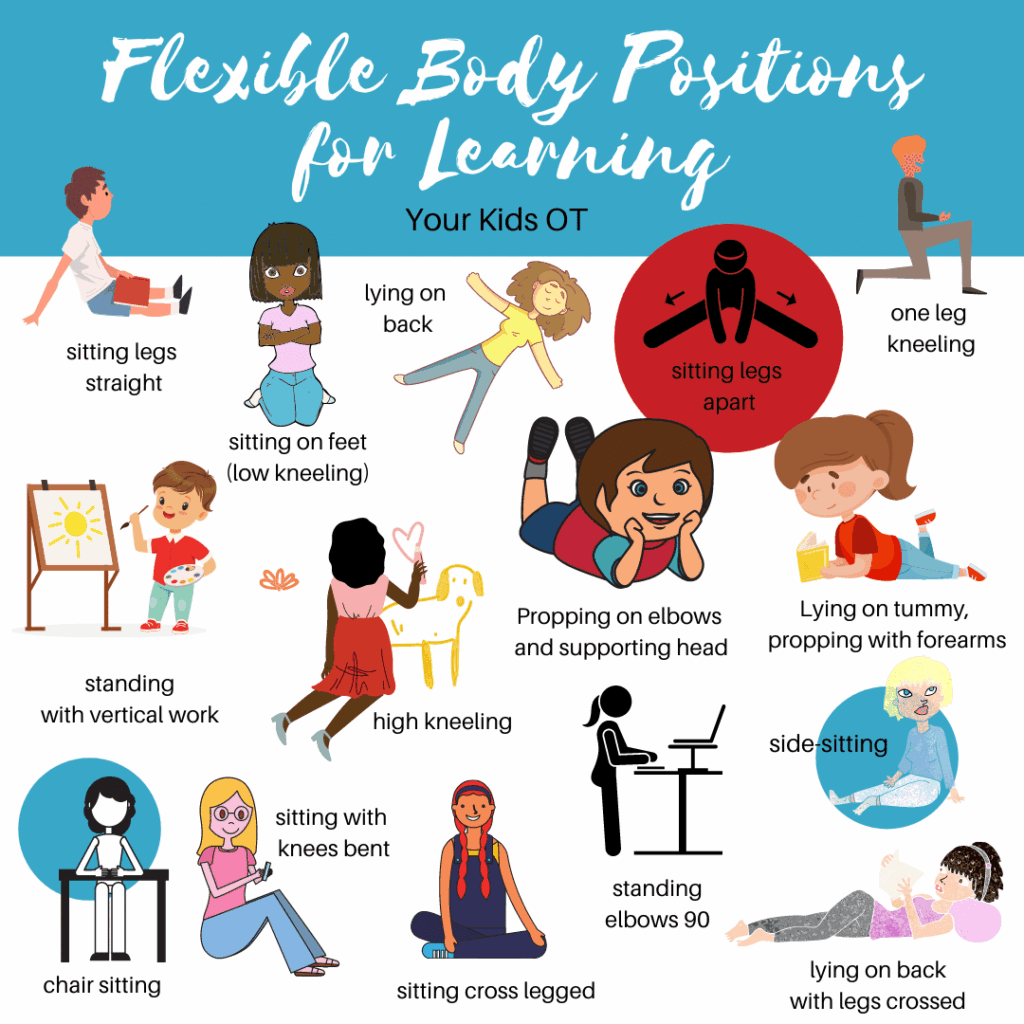
Allow for floor sitting options. “Criss-Cross-Applesauce” can be painful and distracting. Allow for possible alternative ways to sit. Here are some options from the Your Kids OT blog:
A Few More Concepts to Keep in Mind:
- Some neurodivergent children have a difficult time reading facial expressions. For example, they might mistake a teacher’s neutral face for anger or disgust.
- When a child is deeply focused, they may no longer hear you. It’s not that they aren’t listening, it’s that they don’t hear you. When a child is hyper-focused they may miss internal body cues such as hunger, thirst, aches and restroom signals. Hyperfocus isn’t a bad thing, in fact you might see it as a “superpower” of ADHD. But it helps to be aware that the child isn’t ignoring you or misbehaving.
- A child or teen successfully completing a task last week isn’t proof they are capable of the same task today. Our energy and bandwidth are finite resources and can get depleted or maxed out. They may have an “empty tank,” today.
- Giftedness is also a neurological difference that requires appropriate accommodation. Gifted children tend to be asynchronous in development, meaning a 9 year old could have the vocabulary of a 15 year old, the math ability of an 11 year old, age-typical handwriting, and the emotional maturity of a 7 year old. Access to learning and challenge also often requires options for acceleration.
- Remember that behavior is communication. When a child exhibits unwanted behavior, there’s a story behind it. The child is communicating an unmet need or lagging skill. We can get curious and observe the pattern of behavior to figure out how to support the need. For more about this, grab psychologist Dr. Ross Greene’s book, The Explosive Child.
Thanks for reading!
Warmly,
Christina
Leave a Reply